
Chimney cap replacement means removing a failed or worn-out cap and fitting a new one over your flue. It is the right call when the existing cap has rusted through, lost its mesh, been crushed, or blown off entirely, letting rain, animals, and debris straight into your chimney. This is different from a first-time cap installation on a flue that never had one, and different from repairing a cap that is still structurally sound. If yours is corroded or damaged, replacing it now is far cheaper than repairing the water and animal damage a missing cap invites into your masonry and firebox.
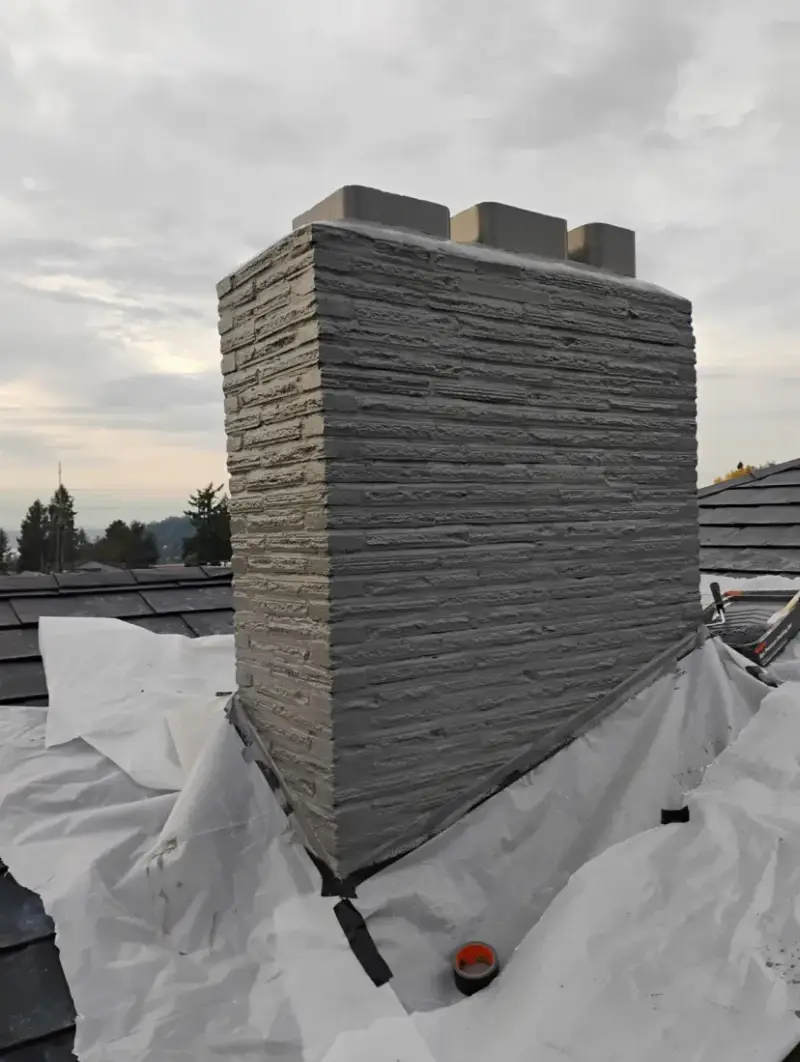
What chimney cap replacement covers
The cap is the metal cover that sits over the top of your flue. A good one does three jobs at once: it keeps rain out of the flue, it screens out birds, squirrels, and raccoons, and it stops burning embers from drifting onto your roof. When any of those functions fail, the cap needs to be swapped rather than patched.
Replacement specifically covers taking off the old, failed cap and securing a correctly sized new one to your flue tile or liner. It is not the same as a first-time installation, where no cap has ever been present and we assess mounting from scratch, and it is not cap repair, where a sound cap simply needs a fastener, screen, or minor fix. If your chimney has a large factory-built chase instead of a single clay flue, the cover involved is a chase cover, which is a related but separate component.
Common reasons a cap needs replacing
- Rusted through: galvanized steel corrodes quickly in our wet climate; once you see rust streaks or holes, it is past saving.
- Missing mesh: the screen has rusted away or torn, so animals and embers now have an open path.
- Crushed or bent: a fallen branch, ladder, or heavy snow load has deformed it.
- Blown off: wind has taken it entirely, or you found it in the yard.
- Wrong size or loose: a previous cap was never properly fitted and rattles or lets rain past the edges.
Signs you need a replacement, not a repair
Some cap problems are worth fixing. Many are not. Replace rather than repair when you see rust holes, a corroded or missing screen, cracked or crushed metal, or an ill-fitting cap that a fastener alone will not solve. If your cap is only a few years old, made of stainless or copper, and merely needs a screw or a new clamp, a repair may be all it takes. The honest dividing line is material condition: once corrosion has eaten through the metal, no repair restores it.
What to expect from the service
We start on the ground and on the roof with a real look at your chimney top, because cap sizing and mounting depend on your exact flue dimensions and crown condition, which cannot be judged remotely from a photo. We measure the flue, confirm whether you need a single-flue cap, a multi-flue cap, or a full-width cover, and check that the crown underneath is sound. A cap bolted over a crumbling crown only hides a bigger problem, so if the crown is failing we will tell you and treat that separately.
Once the right cap is selected, we remove the old one, clean the mounting surface, and secure the new cap to the flue or liner. We walk you through the material options and what each will cost, since price depends on flue size, number of flues, access, and whether you choose stainless steel or copper. We do not quote cap replacement sight-unseen or advertise a single flat price; you get a real quote after we see the chimney.
Material choices, plainly
- Galvanized steel: cheapest up front, but rusts fastest. In the Northwest it is often a false economy.
- Stainless steel: the practical long-term standard; resists corrosion for decades and holds up to constant moisture.
- Copper: the longest-lasting and best-looking option; a premium choice that ages to a natural patina.
Why use a professional
Cap replacement happens at the very top of the chimney, at the roofline, in the one spot where a slip has serious consequences. Beyond the fall risk, correct sizing matters: an undersized cap restricts draft and can worsen smoke problems, while an oversized or loosely mounted cap lets rain drive in around the edges and blows off in the next windstorm. A professional also spots the problems a cap swap can reveal, such as a cracked crown, a deteriorating liner top, or rust that has already started inside the flue. For safety reasons we handle the roof work rather than walk a homeowner through it.
Why this matters in your local area
Our climate is exactly the environment that kills cheap caps. Months of steady rain keep a metal cap wet far longer than in drier regions, and repeated freeze-thaw cycles work moisture into every seam. A failed cap here does not just let in the occasional shower; it feeds a slow, constant soak that rots the crown, saturates the masonry, and can carry water down to your ceiling. Choosing a corrosion-resistant cap and replacing a failed one promptly is one of the highest-value moisture defenses on a Northwest chimney. If you are also seeing leaks, it is worth remembering that a cap is not automatically the source, since flashing and crown failures leak too, which is why we inspect the whole top before pointing at one cause. You can read more on our chimney services overview.
Frequently Asked Questions
Can you match a new cap to my existing chimney top?
Yes. We size the replacement to your exact flue or chase dimensions and match the mounting style, whether that is a single-flue cap, a multi-flue cap covering several flues at once, or a full cover. Because sizing has to be measured on-site, we confirm the fit at the chimney rather than guessing from a photo.
Is stainless steel really worth more than galvanized for a replacement?
In a wet climate, almost always. Galvanized caps can rust through in only a few years, meaning you pay again to replace them, while a stainless cap resists corrosion for decades. Copper lasts even longer. Since you are already paying for the labor to swap the cap, the small upgrade in material usually pays for itself.
My cap looks fine but I have a leak. Do I still need a new cap?
Not necessarily. A leak can come from the crown, the flashing where the chimney meets the roof, or the masonry itself, not just the cap. We never diagnose a leak source remotely; we inspect the whole chimney top on-site to find where water is actually getting in before recommending a cap replacement or anything else.
What happens to my chimney if I leave a failed cap unreplaced?
Rain enters the flue directly and soaks the liner, crown, and masonry from the top down. Animals move in and build nests, which block draft and are a fire hazard. Over a season or two you can go from a simple cap swap to needing crown or liner work, so replacing promptly is the cheaper path.