
By the Miles Chimney Sweep team · Published Aug 21, 2026
The honest answer surprises most homeowners: the great majority of chimneys are repairable, and a full rebuild is the exception, not the rule. Cracked mortar joints, a few spalling bricks, a damaged crown, or a worn liner are targeted repairs, not reasons to tear the stack down. A rebuild is reserved for widespread structural failure, deterioration deep enough or extensive enough that the masonry can no longer safely carry its own load. The tricky part is that the two can look similar from the ground. What separates a weekend repair from a rebuild is not how bad it looks, but how deep and how widespread the damage runs, and that can only be judged up close.
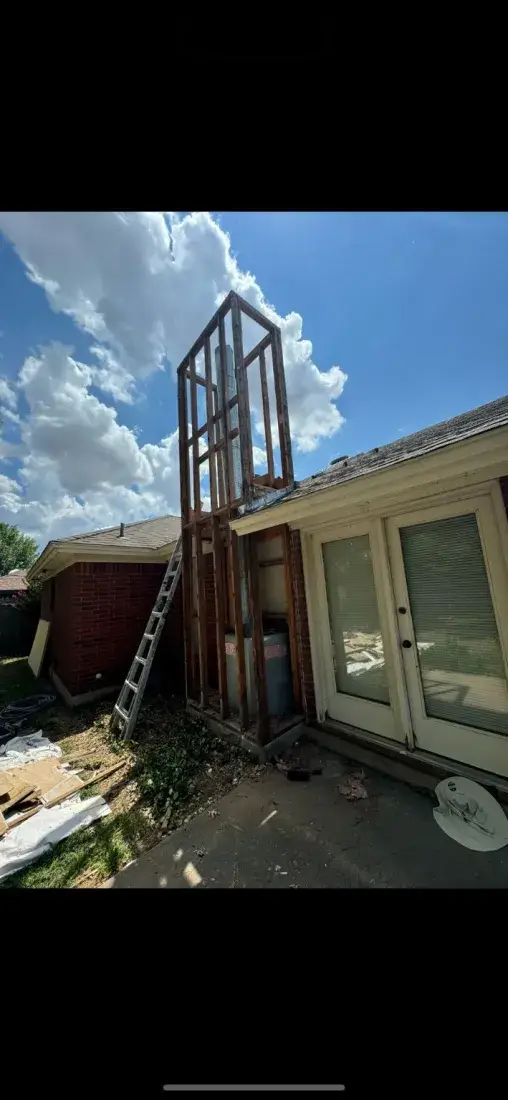
Why most chimneys are repairable
A masonry chimney is built to be serviced. When a mortar joint erodes, a mason removes and replaces it. When the outer face of a few bricks flakes off, those bricks are swapped out. When the concrete crown cracks or the liner deteriorates, that specific component is repaired or replaced. None of that requires taking down the surrounding masonry. The reason repairs work so often is that damage usually starts at the surface and stays there for years before it reaches the structure underneath. Catching it during that window is exactly why NFPA 211 calls for a chimney to be inspected at least once a year for soundness, early findings keep small problems small.
The factors that actually push toward a rebuild
A rebuild, partial or full, enters the picture only when the masonry has lost its structural integrity across a meaningful portion of the stack. The main drivers are:
- Deep spalling through the wall. Spalling is the flaking and crumbling that happens when water soaks into brick, then freezes and expands, a real concern in the wet, freeze-thaw winters. A few surface-spalled bricks are a spot repair. But when spalling has eaten through a large share of the chimney face and into the load-bearing thickness of the brick, patching no longer restores strength.
- A leaning or tilting stack. A chimney that is visibly out of plumb signals a failing foundation, a shifted footing, or masonry that has lost cohesion. Leaning is one of the clearest signs the problem is structural rather than cosmetic.
- Widespread mortar and brick failure. When mortar has washed out across most joints and bricks are crumbling in multiple areas at once, not one patch, the wall can no longer hold together as a unit.
- Repairs that keep failing in new spots. If tuckpointing and brick replacement fix one area only for the next section to fail, the underlying masonry has often reached the end of its service life.
Warning signs worth a closer look
- Bricks flaking, popping, or crumbling, with fragments collecting on the roof or ground
- Any visible tilt or gap opening between the chimney and the house
- Mortar joints you can rake out with a finger or that have washed away
- Wide vertical or stair-step cracks running through the brickwork
- Interior signs of water, stains on the ceiling or wall around the chimney
What you can safely do yourself
Stay on the ground. From the yard or a window, look at the stack against a straight vertical reference like a corner of the house to judge whether it is plumb. Note where debris is falling and photograph anything that has changed. Keep the firebox unused if you see a lean or significant crumbling. What you should not do is climb onto the roof to probe the masonry, and you should not try to diagnose the extent of structural damage from photos, depth of spalling, footing condition, and internal cracking genuinely require hands-on evaluation.
How a professional decides
An on-site inspection is the only reliable way to separate a repair from a rebuild. A technician evaluates the masonry up close: how far the spalling has penetrated, whether the stack is truly plumb, how sound the mortar is below the surface, and whether the crown, liner, and flashing are contributing to the moisture that caused the damage. The outcome is often more modest than the homeowner feared, tuckpointing, selective brick replacement, or crown work, rather than a rebuild. When a partial rebuild of the top courses or an above-the-roofline section is warranted, that is a defined scope, not automatically a full teardown. If you are seeing crumbling brick, our guide to why chimney bricks crumble or flake explains the cause, and if the stack looks off-vertical, read why a chimney leans before you use the fireplace again.
Prevention: keep repair from becoming rebuild
Because water is the driver behind nearly all of this, keeping water out is what preserves a repairable chimney. A sound chimney cap, intact crown, good flashing, and periodic waterproofing break the freeze-thaw cycle before it reaches structural brick. Pair that with the annual inspection standard, and most chimneys stay firmly in repair territory for decades. Questions? Call 866-309-2130 or request a quote.
Frequently Asked Questions
Can a chimney be partially rebuilt instead of fully torn down?
Yes, and it is common. When only the section above the roofline has failed while the masonry below is sound, a mason can rebuild just those courses. A partial rebuild is a defined scope decided on-site, based on where the structural damage actually stops.
How long does a masonry chimney last before it needs a rebuild?
There is no fixed number, service life depends on the original brick and mortar quality, how well water has been kept out, and how consistently the chimney has been maintained. Many masonry chimneys last generations with routine repairs. Neglected moisture control shortens that dramatically.
Is a leaning chimney always a rebuild?
Not always, but a lean is never cosmetic and should stop you from using the fireplace until it is inspected. The right fix depends on the cause, a shifted footing, foundation settlement, or masonry failure, which only an on-site evaluation can determine. Some leans are correctable without a full rebuild.
Does homeowners insurance cover a chimney rebuild?
It depends entirely on the cause and your policy. Damage from a sudden covered event may be handled differently than gradual wear from water and freeze-thaw, which is often treated as maintenance. Check with your insurer directly; we cannot speak to your coverage.
How much does a chimney rebuild cost compared to a repair?
Repairs generally cost far less than rebuilds, but both vary widely with the extent of work, access, brick and materials, height, and local labor, and prices change over time and by region. There is no accurate flat figure without seeing the chimney. Request a quote for a scope-based estimate.